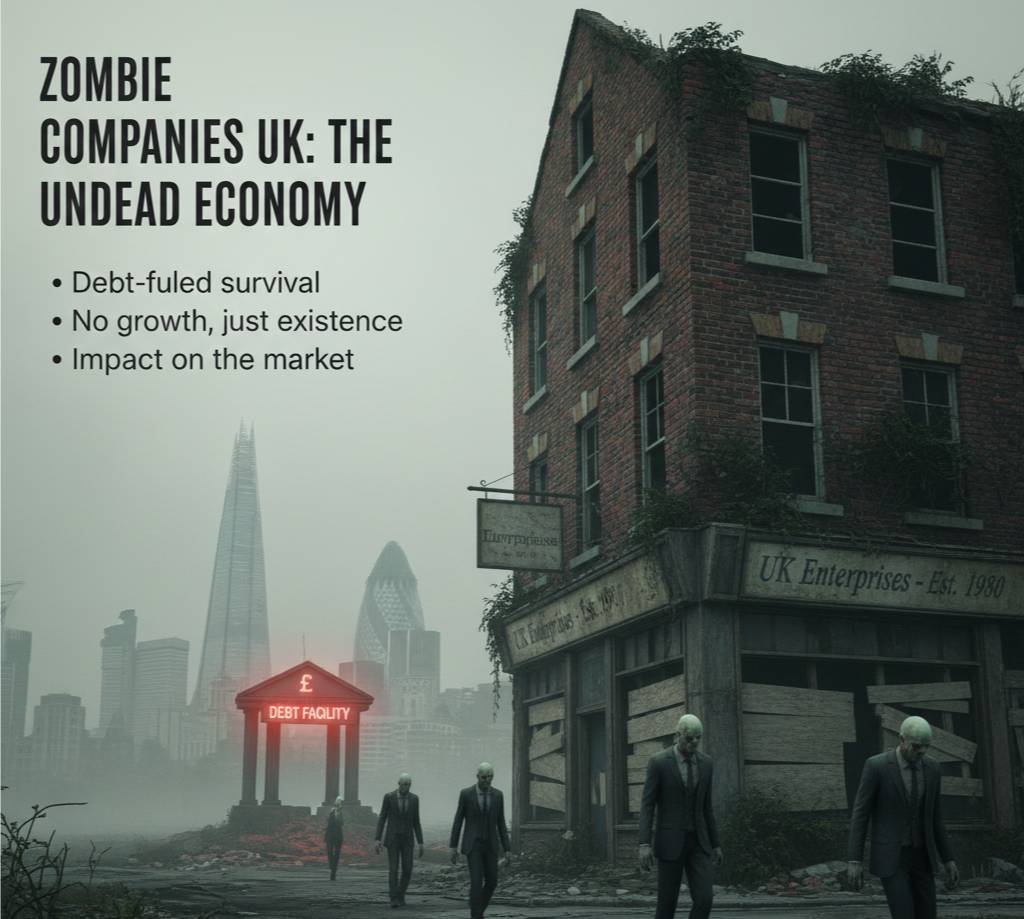
For over a decade, the British economy has been haunted by the “living dead.” These are the so-called zombie companies UK — firms that generate just enough cash to service the interest on their debts but lack the capital to invest, innovate, or grow. They are the atmospheric drag on UK productivity, trapping labor and capital in inefficient cycles.
However, according to a sobering new report from the Resolution Foundation, the “zombie apocalypse” is finally arriving. As we move into 2026, a “triple whammy” of economic pressures is poised to thin the herd. While the resulting spike in unemployment—forecast to hit levels not seen in a decade—presents a harrowing short-term challenge, economists suggest this painful transition may be the necessary catalyst to end Britain’s stagnation and usher in a new era of productivity.
The Triple Whammy: A Perfect Storm for Failure
The survival of unproductive firms since the 2008 financial crisis was largely subsidized by “cheap money.” With interest rates held at historic lows for more than a decade, debt-laden companies could limp along indefinitely. That era is over.
The Resolution Foundation identifies three primary levers currently squeezing the life out of underperforming businesses:
- The End of Cheap Debt: Despite recent marginal cuts by the Bank of England, the base rate remains significantly higher than the near-zero environment of the 2010s. For a company barely breaking even, the transition from a 0.25% interest rate to a 3.75% or 4% rate is the difference between survival and insolvency.
- Surging Input Costs: While headline inflation has cooled from its double-digit peaks, the “stickiness” of energy prices and raw materials means the cost of doing business remains structurally higher than it was pre-pandemic.
- The Wage Floor: Significant increases in the National Living Wage, while vital for protecting low-income households, have placed immense pressure on sectors with thin margins, such as retail, hospitality, and social care. For many zombie firms, the inability to absorb these labor costs is the final blow.
The “Creative Destruction” Paradox
The term “creative destruction,” coined by economist Joseph Schumpeter, describes the process by which industrial mutation incessantly revolutionizes the economic structure from within, incessantly destroying the old one, incessantly creating a new one.
Ruth Curtice, chief executive of the Resolution Foundation, notes that 2026 could be remembered as the year this process finally took hold in the UK. “There are early and encouraging signs of a mild zombie apocalypse,” she stated. By allowing failing firms to go bust, the economy frees up resources—specifically workers and land—to be utilized by more efficient, modern, and high-growth companies.
This is particularly relevant in the context of the Artificial Intelligence revolution. While older firms struggle to integrate new technologies due to a lack of investment capital, newer entrants are building AI into their foundations. The collapse of the old guard provides the breathing room for these tech-driven disruptors to scale.
The Human Cost: Unemployment and Displacement
While “creative destruction” sounds clinical in an economic textbook, its real-world manifestation is unemployment. The UK’s jobless rate reached 5.1% in late 2025, and 2026 is expected to see that figure climb higher as the insolvency wave peaks.
The British Chambers of Commerce (BCC) has highlighted a significant slump in business confidence, with fewer than half of SMEs expecting an increase in turnover. The fear is that the “destruction” phase is currently outpacing the “creative” phase. When a zombie firm closes, its employees do not always transition immediately into high-productivity tech roles. There is a period of friction—job displacement—that threatens to erode living standards in the short term.
Furthermore, the tax environment remains a point of contention. Following Rachel Reeves’s autumn budget, business leaders have been vocal about how increased employer contributions and taxes are deterring them from hiring. If the government wants to mitigate the unemployment spike, it must find a way to incentivize the “productive” firms to absorb the labor being shed by the “unproductive” ones.
The Productivity Puzzle: A Turning Point?
For twenty years, the UK has suffered from a “productivity puzzle.” Output per hour worked has remained stubbornly flat compared to G7 peers like the US, France, and Germany. This stagnation is the primary reason why real wages have barely budged since the mid-2000s.
If 2026 truly is a turning point, it will be because the economy has finally stopped “misallocating” resources. When a zombie firm occupies a prime high-street location or employs 50 people while producing zero growth, it is effectively blocking a better company from using those resources.
The Resolution Foundation’s report suggests that if the UK can weather the social storm of higher unemployment in 2026, the mid-to-late 2020s could see a resurgence in GDP per capita. The adoption of AI, combined with a leaner, more competitive corporate landscape, offers a path out of the low-growth trap.
Policy Implications: Navigating the Transition
The government faces a delicate balancing act. If they move to “save” every struggling business through subsidies or interventions, they risk extending the UK’s productivity malaise for another decade. However, if they allow the “apocalypse” to happen without a safety net, they risk a social crisis.
Key areas for policy intervention in 2026 will include:
- Retraining and Reskilling: Active labor market policies to help workers from dying industries transition into growth sectors like green energy and technology.
- Support for SMEs: Distinguishing between “zombie” firms and viable “gazelle” firms (high-growth startups) that need temporary support to navigate high interest rates.
- Investment Incentives: Ensuring that the tax regime encourages businesses to spend their cash reserves on machinery, software, and R&D rather than just sitting on capital.
Conclusion: Hope Amidst the Hardship
The outlook for 2026 is undeniably “unsettled,” as David Bharier of the BCC put it. For many families, the threat of redundancy and the stagnation of disposable income will make for a difficult year.
Yet, there is a glimmer of optimism in the data. By clearing away the “dead wood” of the corporate landscape, the UK is making room for a more resilient and modern economy. The “zombie apocalypse” may be painful, but it might also be the only way to ensure that the UK doesn’t spend the next twenty years treading water.
As we look toward 2026, the goal for policymakers and businesses alike should not just be survival, but transformation. Only by embracing the “destruction” of the inefficient can the UK hope to “create” a future of rising living standards and genuine economic prosperity.
A Note on Resilience
In times of economic upheaval, independent journalism and clear-eyed analysis are more important than ever. Understanding the forces that shape our world—from interest rate hikes to the rise of AI—allows us to prepare for the changes ahead. Whether it’s a resolution to read more or an effort to stay informed, engaging with the reality of our economic landscape is the first step toward navigating it successfully.